What Kind of World Do You Want?
Barely a week after 9/11, a group came together for a workshop at the University of British Columbia. In the middle of our time together, I asked them:
“After all is said and done, what kind of world do you want? Can you express it in a single word, or maybe two?”
I’d asked these questions of groups many times before. That afternoon, it was different. I spoke with a lump in my throat. The words came out softly, in my deepest voice.
It took some nerve to ask people what they wanted. What room was there for high hopes when our very survival seemed to be at risk?
The first person to answer said she wanted a “safe” world.
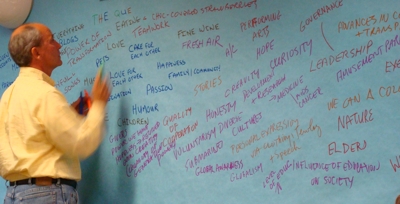
Heads nodded.
We could all relate to that wish. I wrote “safe” at the very top of a large sheet of paper that we’d taped to the wall.
Only seconds passed before Virginia Henderson turned us around.
“I think it’s a different world than safe,” she said. “I think that’s past.”
“It’s a confident world I want.”
In that moment, Virginia shifted our attention. Before she spoke, we’d been focused on our despair, our fear, our hunger for security.
Under the circumstances, it had seemed unthinkable to speak of anything else.
But Virginia’s words opened the possibility that we might face the future with strength. Even more, she showed us we could still find plenty of energy to bring our dreams to life (if we knew where to look).
The group gravitated toward her notion of a “confident” world. I picked up on that and asked them, “Can we see here and now any evidence that some of what we want is already here? Any evidence of a confident world?”
Silence. All of us, eyes moist, turned to look at Virginia, who had just flown half-way around the world from Australia.
(And when she went returned home, she wrapped up her time as civic leader (co-founder of the Australian national Shakespeare company) and her executive role (at the National Gallery of Australia) in order to make new space for her next contribution.)